


Article: The Luxury Watch Market in 2026: Why Gold Is Changing the Value of Vintage Watches
The Luxury Watch Market in 2026: Why Gold Is Changing the Value of Vintage Watches
It is an unusual time for the luxury watch market. Swiss watch exports are growing, pre-owned prices are recovering unevenly, and the rising price of gold has created a situation that would have seemed almost unthinkable a few years ago: some vintage luxury watches are now worth more melted down than they are as complete timepieces.
For collectors, this raises an interesting question. What really determines the value of a vintage watch? Is it the brand, the rarity, the craftsmanship, or simply the precious metal from which it was made?
As we approach the end of 2026, the answer is becoming increasingly important.

The Luxury Watch Market in 2026: A Recovery, but Not for Everyone
The latest figures suggest that the Swiss watch industry is finding its footing again.
According to the Federation of the Swiss Watch Industry, Swiss watch exports increased by 9.1% in October 2026 compared with the previous year, marking a fifth consecutive month of growth. Total exports for the first ten months approached CHF 22 billion, up 3.4% year on year.
However, the secondary market tells a slightly different story.
The WatchCharts November 2026 report recorded a 0.8% decline in its overall market index during October. Rolex prices fell 1.1%, while Patek Philippe declined 0.4%. Audemars Piguet, meanwhile, managed a modest 0.2% increase.
Despite these monthly declines, the broader index remained approximately 7% higher over the preceding twelve months.
These figures are not necessarily contradictory. Swiss export statistics measure watches leaving Switzerland, rather than purchases by the end consumer. Secondary-market indices track a different part of the industry altogether.
What they illustrate is a market that has become far more selective.
The extraordinary conditions of 2021 and 2022, when certain modern sports watches traded at substantial premiums and buyers competed aggressively for allocations, have largely given way to a more measured market.
Collectors can afford to be more discerning. Brand recognition remains important, but condition, originality, rarity and individual reference numbers deserve considerably more attention than a general movement in prices.
The Gold Market Has Created an Unexpected Problem
Perhaps the most extraordinary development of 2026 has been the effect of rising gold prices on vintage watches.
In June, Reuters reported that a number of vintage and pre-owned gold watches were being dismantled and melted down because their precious-metal content was worth more than their resale value as watches.
One particularly striking example involved an 18-carat gold Omega Constellation dating from the late 1970s.
Despite being in excellent condition, the watch was reportedly melted down after its gold content was valued at approximately £5,750. Its estimated auction value as a complete watch was between £4,000 and £4,500.
In other words, the gold alone was worth considerably more than the watch.
From a purely financial perspective, the decision is understandable. From a collector's perspective, however, something irreplaceable has been lost.
Once melted down, a vintage watch can never be recovered in its original form. The case, bracelet, workmanship and history of the piece disappear permanently.
It is also important to understand that this does not apply to every gold watch. Certain desirable references can command substantial premiums over their intrinsic metal value, while others have relatively limited collector demand.
Nevertheless, it demonstrates how dramatically the relationship between precious metals and vintage watch valuations has changed.
A Vintage Gold Watch Has Two Different Values
When assessing a vintage gold watch, there are effectively two separate considerations.
The first is its intrinsic precious-metal value.
An 18-carat gold watch contains gold with a purity of 75%, although the total weight of the watch should never be confused with its actual gold content. Movements, crystals, dials and various internal components contribute weight without necessarily contributing to the precious-metal value.
The second is the value of the watch as a collectible object.
This is where things become considerably more interesting.
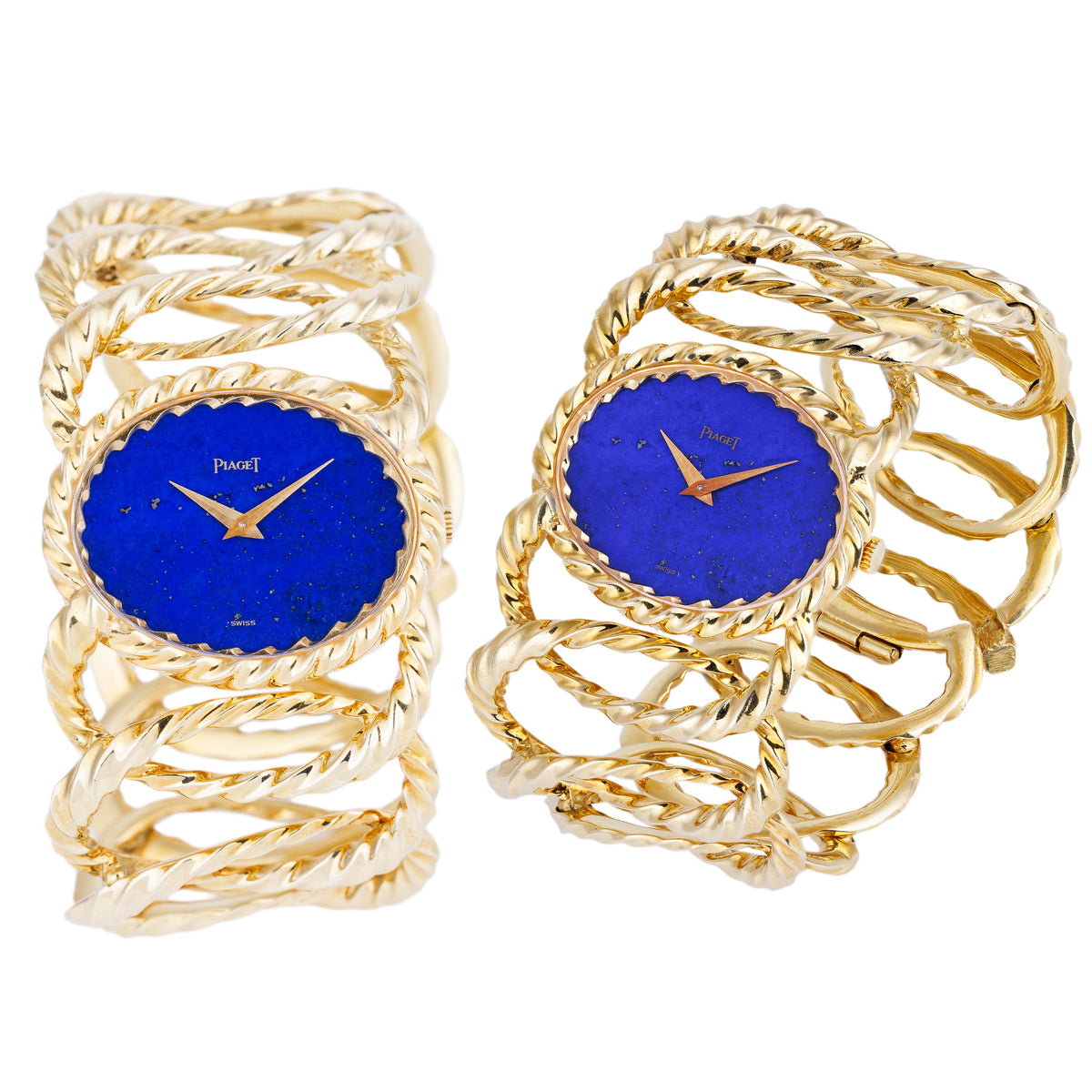
A vintage Piaget with an unusual integrated gold bracelet, a Cartier Tank with beautifully preserved original details, or an elegant Patek Philippe Golden Ellipse cannot be assessed simply by weighing its gold.
These watches reflect particular periods of design, craftsmanship and watchmaking history.
Consider the elaborate gold bracelets produced by Piaget during the 1960s and 1970s. Many were designed as much as pieces of fine jewellery as instruments for telling the time. Their intricate construction, unusual finishes and distinctive case shapes represent workmanship that goes well beyond the value of the material itself.

The same can be said for certain vintage Cartier creations, where recognisable silhouettes, unusual proportions and distinctive designs are fundamental to their appeal.
A watch's value therefore depends on more than its brand name or gold content. The reference, condition, originality, rarity and demand among collectors all have a significant part to play.
Could Rising Gold Prices Make Certain Vintage Watches Rarer?
There is another aspect of this development worth considering.
Unlike modern production watches, vintage pieces exist in a finite supply. Once a particular reference is discontinued, no further original examples will be manufactured.
Every watch that is subsequently dismantled for its gold content permanently reduces the number of surviving examples.
This does not automatically mean that the remaining watches will increase in value. Scarcity alone is not enough; there must also be genuine collector demand.
However, it introduces an interesting dynamic into an already complex market.
A relatively overlooked vintage watch today could become more difficult to find in original condition over time, particularly if examples continue to be broken down for their precious-metal content.
For collectors who appreciate unusual case designs, original gold bracelets and the craftsmanship of earlier decades, preservation may become an increasingly important consideration.

What Should Collectors Look for When Buying Vintage Gold Watches?
The rising value of gold is certainly relevant, but it should never be the only consideration when purchasing a vintage timepiece.
Originality remains one of the most important factors.
A well-preserved watch with its original dial, correct components and an undamaged case can be considerably more desirable than an example that has undergone extensive restoration.
This becomes particularly important with watches featuring unusual case shapes, integrated bracelets or decorative finishes. Excessive polishing can permanently alter the original contours and character of a watch.
The bracelet also deserves careful attention. With some vintage gold watches, the bracelet is an integral part of the original design rather than an interchangeable accessory. Its condition, length and originality can materially influence both desirability and value.
Buyers should also consider the movement, service history, authenticity and availability of replacement parts.

Most importantly, a vintage watch should be assessed individually. Two examples of the same reference can command very different prices depending on their condition and originality.
Is 2026 a Good Time to Buy a Pre-Owned Luxury Watch?
There is no universal answer.
The secondary market has recovered from much of the uncertainty that followed the speculative highs of 2022, but performance remains inconsistent across individual brands and references.
For buyers interested in modern Rolex, Patek Philippe or Audemars Piguet watches, current secondary-market pricing may offer a different proposition from the premiums seen during the market's peak.
For those interested in vintage gold watches, the considerations are somewhat different.
The underlying gold value is increasingly relevant, but the most interesting opportunities may lie in understanding the craftsmanship, design and rarity of individual pieces.
Rather than attempting to predict which brand will appreciate fastest, collectors may be better served by focusing on watches they genuinely appreciate, purchasing carefully and understanding exactly what they are buying.
A watch should ultimately be something to own and enjoy, rather than a guaranteed financial investment.
Thinking of Selling a Vintage Gold Watch?
For owners of vintage gold watches, the current market creates both opportunities and challenges.
The value of a watch's gold content may have increased significantly, but selling purely on the basis of its metal weight could mean overlooking its potential value as a complete collectible timepiece.
Before selling an older gold watch, particularly an unusual or discontinued reference, it is worth obtaining a specialist assessment.
A knowledgeable watch dealer can consider the model, reference, originality, condition and current collector demand alongside its precious-metal content.
In some instances, the market value of the watch may comfortably exceed its intrinsic gold value. In others, the two figures may be surprisingly close.
Understanding that difference is essential before deciding what to do with a piece.
Our Perspective: The Value of a Watch Goes Beyond Its Weight in Gold
The luxury watch market is entering an interesting period.
After several years dominated by rapidly rising prices, waiting lists and speculation surrounding a relatively small number of modern models, the market is becoming more nuanced.
Gold prices, changing consumer preferences and the growing sophistication of the secondary market are all influencing how collectors assess value.
For us, the appeal of vintage watches has always extended beyond their material worth.
An exceptional vintage timepiece represents the design and craftsmanship of its era. Whether it is an unusual Piaget, an elegant Cartier, a classic Rolex or a rare Patek Philippe, its character comes from something that cannot simply be reproduced by melting down the gold.
And perhaps that is the most important consideration of all.
Gold can be refined and reused. An original vintage watch, once destroyed, is gone forever.
At Watch Collectors, we specialise in buying, selling and sourcing exceptional luxury and vintage timepieces. Explore our collections of vintage and pre-owned Piaget watches, Cartier watches and Patek Philippe watches.
If you are considering selling a watch or would like to understand its current market value, you can also request a valuation or arrange a private appointment with our specialists in Mayfair, London.


